Traders who blow a prop firm evaluation don't blow it with a single bad trade. They blow it because their loss limit moved somewhere they didn’t expect, and a normal pullback suddenly became a breach.
Trailing drawdown is usually the rule behind it. This guide explains what a trailing drawdown is, how intraday and end-of-day versions differ from a static drawdown, and how each one works on Vanquish’s plans.
It sits alongside our other rule guides in the Vanquish Trader rules overview.
What is trailing drawdown in a prop firm?
A trailing drawdown is a loss limit that moves up as your account reaches new highs and never moves back down. The gap between your highest equity and your loss limit stays the same size; it just follows you up.
Loss limit = Highest equity − Maximum drawdown
Say your $50,000 account has a $2,500 trailing drawdown. You start with a loss limit of $47,500. Run the account up to $53,000, and the limit follows to $50,500. You haven’t gained any extra room to lose. The same $2,500 gap has simply moved higher.
That’s the part that catches people out. With a trailing drawdown, profits don’t widen your cushion. They raise the floor. A strong morning can leave you in a tighter spot by the afternoon if you give some of it back, because the limit followed you up and stayed there.
The three types of drawdown
Prop firms handle drawdown in one of three ways. The clearest way to see the difference is to run the same two trading days through each one.
Here’s the scenario: a $50,000 account with a $2,500 maximum drawdown.
- Day 1: QQQ calls run, and your equity touches $51,800 midday. You close the day at $51,200.
- Day 2: An open NVDA call position dips your equity to $49,200 before lunch. It recovers, and you close the day at $50,600.
Intraday trailing drawdown
An intraday trailing drawdown updates in real time. Every new equity high, including profit on open trades, moves your loss limit up immediately.
On day 1, the $51,800 peak lifts your limit to $49,300, even though you closed lower. On day 2, the dip to $49,200 goes below that limit, and the account is breached. It doesn’t matter that the trade recovered later.
This is the strictest version. It rewards traders who take profit into strength and keep open positions sized so that a normal pullback can’t reach the limit.
End-of-day trailing drawdown
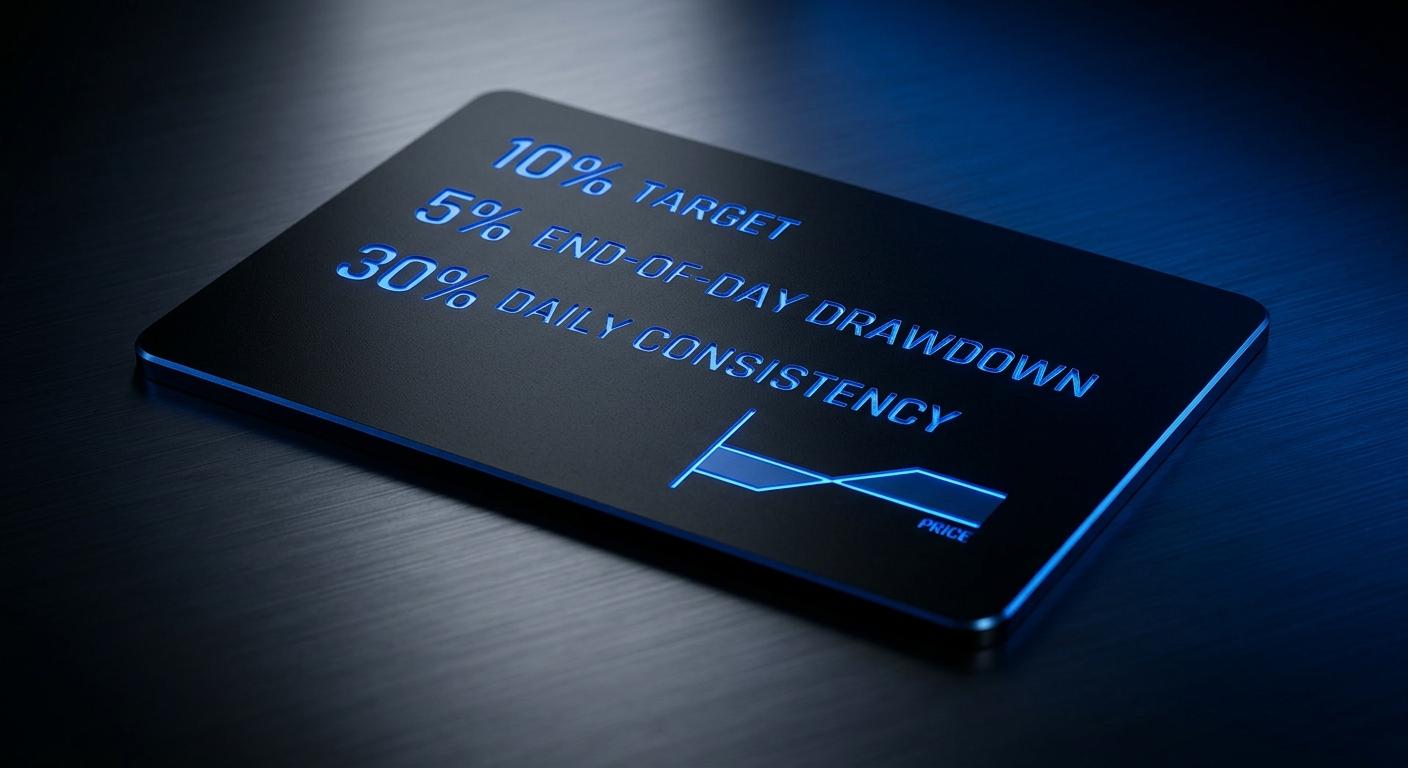
An end-of-day trailing drawdown only moves once a day, after the close, based on where your equity finished. Highs during the session don’t count.
On day 1, the limit moves to $48,700, based on the $51,200 close rather than the $51,800 peak. On day 2, the dip to $49,200 stays $500 above the limit, so the account survives. You close below day 1’s finish, so the limit stays at $48,700.
One thing to be clear on: the limit still applies all day. End of day changes when the limit moves, not when it’s enforced. If your equity had touched $48,700 on day 2, the account would have been breached on the spot.
Static drawdown
A static drawdown never moves. Your loss limit is set on day one and stays there, however much the account grows.
In the scenario, your limit is $47,500 throughout. On day 2, the dip to $49,200 leaves $1,700 of room. With a static limit, every dollar of profit adds to your cushion.
The weak point of a static drawdown is the start. Before you’ve built any profit, you have the least room you’ll ever have.
The same two days, three outcomes
Intraday trailing | End-of-day trailing | Static | |
|---|---|---|---|
Loss limit after day 1 | $49,300 | $48,700 | $47,500 |
Day 2 dip to $49,200 | Breached | Survives, $500 of room | Survives, $1,700 of room |
Loss limit after day 2 | n/a | $48,700 | $47,500 |
Trailing vs end-of-day vs static drawdown
Intraday trailing | End-of-day trailing | Static | |
|---|---|---|---|
When the limit moves | Every new equity high, in real time | Once a day, after the close | Never |
Does open profit move it? | Yes | No | No |
Can you be breached during the day? | Yes | Yes | Yes |
Tightest moment | Right after a run-up that pulls back | After a strong close followed by a weak open | The very start, before any profit |
Profit widens your cushion? | No | No | Yes |
None of the three is easier in every situation. They reward different habits.
Intraday trailing suits traders who scalp or day trade with tight exits. If you bank gains quickly and rarely let a winner swing back, the limit rarely gets close.
End-of-day trailing suits traders whose positions need room during the session. That includes anyone holding a trade through a few choppy hours, and options traders running spreads that can look worse midday than they finish.
Static drawdown suits traders who are careful early and build steadily. Once you have a profit cushion, it’s the most forgiving of the three.
Trailing drawdown vs maximum drawdown
The two terms get mixed up, but they describe different things. Maximum drawdown is the size of the gap, such as 3% or 5% of your starting balance. Trailing, end-of-day and static describe how the limit behaves once it’s set. A plan with a 5% maximum drawdown can use any of the three.
How drawdown works on each Vanquish plan
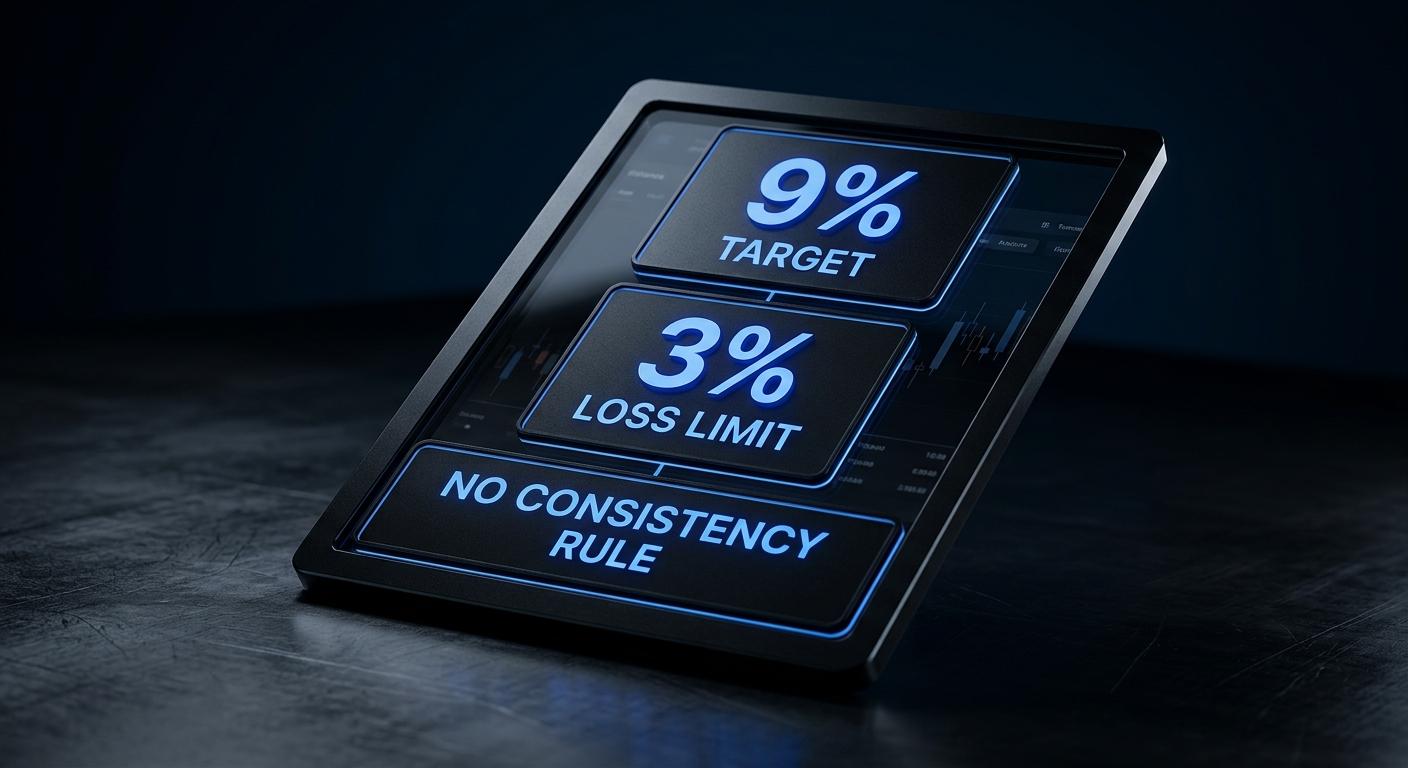
Every Vanquish plan uses a trailing drawdown, either intraday or end of day. There’s no daily loss limit on any plan, so the trailing loss limit is the only drawdown rule you need to track.
Plan | Maximum drawdown | Drawdown type | Buffer checked | Loss limit locks at |
|---|---|---|---|---|
5% | Intraday trailing | In real time | 0.75% above starting equity | |
5% | End-of-day trailing | At the close | 0.75% above starting equity | |
3% | Intraday trailing | In real time | 2.75% above starting equity | |
3% | End-of-day trailing | At the close | 2.75% above starting equity |
The split follows the trading each plan is built for. Advanced Options allows spreads, iron condors and selling to open, and multi-leg positions often look worse in the middle of the session than they finish. An end-of-day limit gives them room to work. Rapid Elite offers the same breathing room on long calls and puts, while Basic Options and Rapid Express reward traders who manage open profit tightly.
What changes on a Performance Account
Once you pass, your drawdown keeps working the same way. Your loss limit trails exactly as it did in the Evaluation, intraday or end of day, until your equity reaches the Buffer.
The Buffer sits 5.75% above your starting equity on every plan. When you reach it, your loss limit locks permanently, and from that point it behaves like a static drawdown. It won’t move up as your account grows, and it won’t move down when you take a payout. Every dollar of profit above the Buffer adds to your room.
On a $10,000 Rapid Express account, for example, the limit trails until your equity reaches $10,575, then locks at $10,275 for the life of the account. Our guide to the Buffer shows the locked levels for every account size, and here’s a fuller look at how the Evaluation and Performance Account differ.
How to trade with a trailing drawdown
- Know your limit before the open. Check where your loss limit sits each morning, not just where your balance is. On a trailing plan, those two numbers move independently.
- Treat a strong morning as a reason to slow down. After a run-up, your limit has moved closer. Pressing for more and giving half of it back costs real room.
- Take profit into strength on intraday plans. An open winner that spikes and fades still lifts your limit to the spike. Scaling out as it runs locks in gains without leaving the limit stranded above you.
- Size for the worst moment of the day, not the close. Even on an end-of-day plan, the limit is enforced intraday. A spread that dips hard at 11 a.m. can breach the account before it ever recovers.
- Remember that losses carry over. The limit never resets overnight. If you finish the day $300 down with a $500 drawdown, you start the next one with $200 of room.
- Aim for the Buffer. Once your limit locks, your drawdown stops trailing, and profit becomes cushion.
Trailing drawdown FAQ
What is trailing drawdown in a prop firm?
It’s a loss limit that follows your highest equity upward and never moves back down. Your limit always sits a fixed amount below your peak, so profit raises the floor rather than adding room.
What’s the difference between trailing and end-of-day drawdown?
An intraday trailing drawdown moves the moment your equity hits a new high, including open profit. An end-of-day drawdown only moves after the close, based on your closing equity. Both are enforced throughout the day.
Is static drawdown better than trailing drawdown?
Not always. Static drawdown is more forgiving once you’ve built profit, but you start with the least room you’ll ever have. Trailing drawdown is tougher after a run-up, but its gap never shrinks below your maximum drawdown.
Does trailing drawdown include unrealized profit?
On an intraday trailing plan, yes. Open profit counts toward your equity high, so the limit can move up before you close a trade. On an end-of-day plan, only your closing equity counts.
Does my loss limit reset each day?
No. On every Vanquish plan, the loss limit carries over from one day to the next and never moves down.
Does trailing drawdown ever stop?
Yes. On a Vanquish Performance Account, your loss limit stops trailing once you reach the Buffer, 5.75% above your starting equity, and locks permanently.
Which Vanquish plans use end-of-day drawdown?
Advanced Options and Rapid Elite. Basic Options and Rapid Express use intraday trailing drawdown.
Ready to pick the drawdown style that fits how you trade? Compare the plans on the plans page.