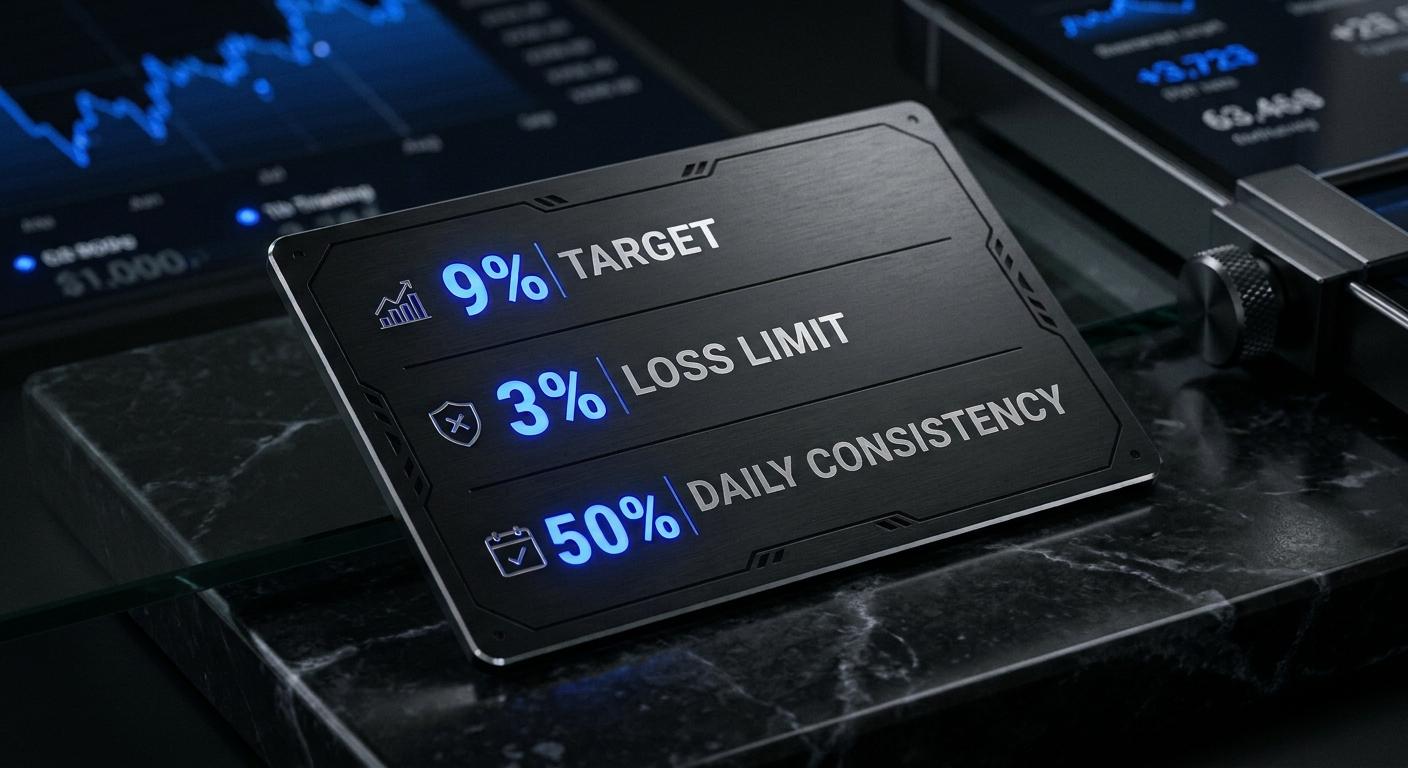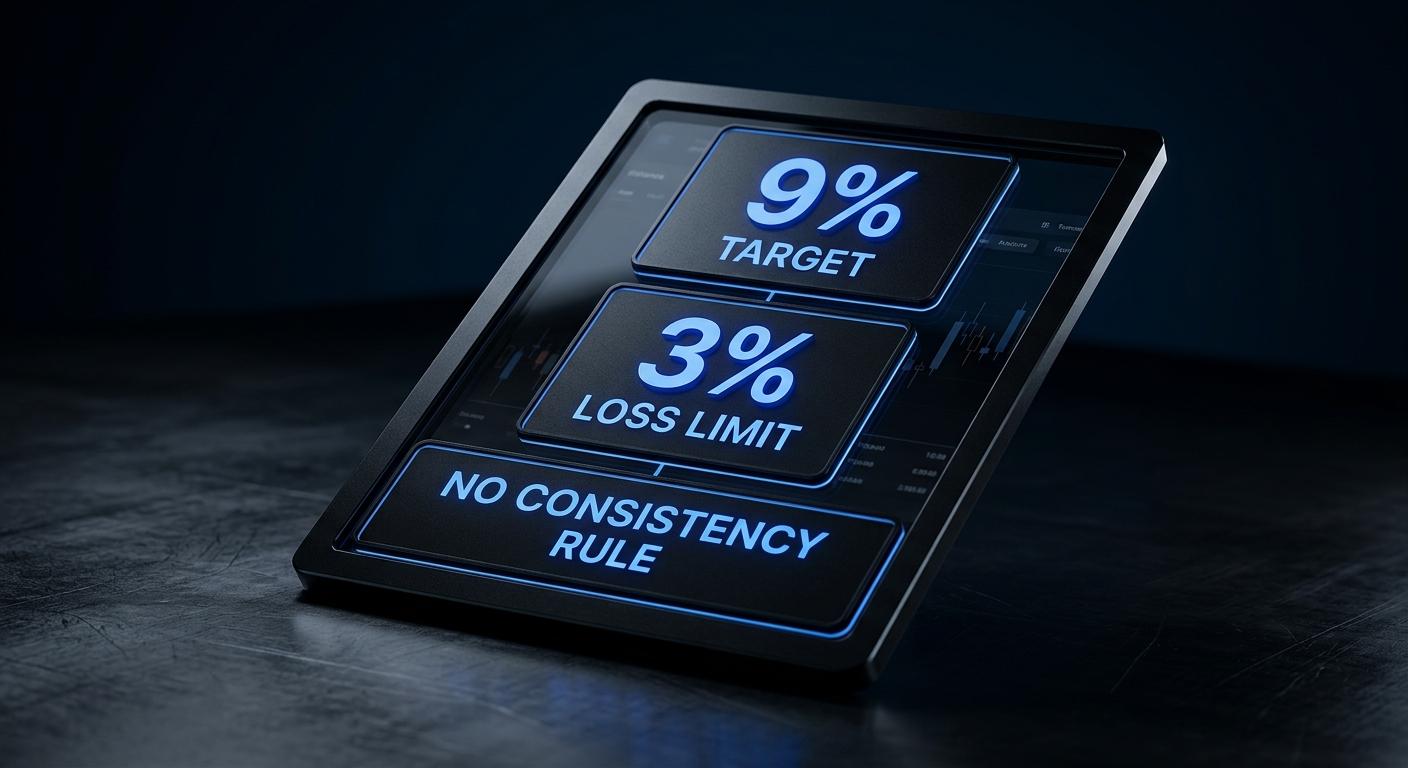
Rapid Express is built for one thing: getting you through the Evaluation fast. There’s no consistency rule and no minimum number of trades, so one well-timed trade on NVDA or META can be enough to pass, even on your first day.
That speed comes with a tighter leash. Your loss limit is 3%, and it trails your equity in real time, open profit included. Below, we walk through every Rapid Express rule, from your first Evaluation trade to your first payout. If you’re still choosing a plan, our Vanquish Trader rules overview puts all four side by side.
Who Rapid Express is for
Rapid Express suits traders who already have an edge and want to prove it quickly. Maybe you trade momentum in AI names like PLTR and SMCI, or you buy short-dated AAPL calls into earnings. If your best trades come in bursts, the missing consistency rule means a big winner never counts against you.
It’s a tougher fit if you like to give open trades plenty of room. Because the loss limit follows your highest unrealized balance, a winner that runs and then fades eats into your cushion before you’ve closed it. Traders who want their limit to move only at the close tend to prefer Rapid Elite, which uses an end-of-day drawdown.
Rapid Express pricing and account sizes
Rapid Express is billed monthly, from $79 for a $10,000 account to $599 for $150,000. The fee covers both the Evaluation and the Performance Account, and it runs for as long as the account is active.
Account size | Monthly price | Reset cost | Profit target (9%) | Loss limit (3%) |
|---|---|---|---|---|
$10,000 | $79 | $39 | $900 | $300 |
$50,000 | $199 | $99 | $4,500 | $1,500 |
$75,000 | $299 | $149 | $6,750 | $2,250 |
$100,000 | $399 | $199 | $9,000 | $3,000 |
$150,000 | $599 | $299 | $13,500 | $4,500 |
If you breach, you don’t have to wait for your next billing date. You can reset straight away for the cost shown above. There’s no time limit on the Evaluation either, so you can take as long as you need.
Rapid Express Evaluation rules
To pass, you need a 9% profit on closed trades without your equity touching the loss limit. That’s the whole list. No consistency rule, no minimum trades, no daily loss limit and no deadline. Here’s how each rule works in practice, and the Rapid Express section of our Help Center has more worked examples if you want to go deeper.
Profit target: 9%
Your target is 9% of your starting balance, which works out to $900 on a $10,000 account. Only closed trades count. If a MSFT call is up $1,000 and you’re still holding it, you haven’t passed yet. The moment you sell and lock that profit in, you have.
Maximum drawdown: 3%
Your maximum drawdown is 3% of your starting balance: $300 on a $10,000 account, up to $4,500 on $150,000. If your equity, including open positions, reaches the loss limit at any point in the day, the Evaluation ends.
How the intraday trailing drawdown works
Your loss limit starts 3% below your starting balance and rises every time your equity sets a new high. That happens in real time and includes open trades. The limit never moves down, and it carries over from one day to the next.
Here’s how it plays out on a $10,000 account:
- You start at $10,000, so your loss limit is $9,700.
- You buy GOOGL calls and the position runs. Your equity peaks at $10,400 while the trade is still open, which lifts your loss limit to $10,100.
- The calls fade and you close at $10,250. You’ve banked $250, but your limit stays at $10,100. You now have $150 of room, not $300.
That’s why position sizing matters so much on this plan. A trade that spikes and gives back its gains still raises your limit. Our guide to trailing drawdown compares this with end-of-day and static drawdowns if you want the bigger picture.
No consistency rule
Most prop firm plans have a consistency rule that caps how much of your profit can come from one trade or one day. Basic Options and Advanced Options set that cap at 30%, and Rapid Elite has a daily rule of its own. Rapid Express has none, in the Evaluation or on the Performance Account. If one AMD put covers the whole target, it still counts.
No minimum trades or trading days
There’s no minimum number of trades or trading days. Hit the target with a single trade on day one, and you’ve passed.
Other Evaluation rules
- No daily loss limit. Only the trailing loss limit applies.
- No overnight positions. Every trade has to be closed by 3:59 p.m. ET, or it’s closed automatically at market. Closing a few minutes early yourself usually gets a better fill.
- No margin.
- No withdrawals. Profit made in the Evaluation can’t be paid out. Payouts come from your Performance Account.
Rapid Express Performance Account rules
Once you pass, you move to a Rapid Express Performance Account, and the rules get simpler. There’s no profit target, no consistency rule and no minimum number of trades. The 3% loss limit stays, trailing your equity in real time until you reach the Buffer. If you’re new to the jump from Evaluation to funded, here’s how the two account stages differ.
The Buffer
The Buffer is the point where your loss limit stops trailing and locks for good. On Rapid Express, it sits 5.75% above your starting equity and is checked in real time, so open profit counts. Once you reach it, your loss limit locks at 2.75% above your starting equity.
Account size | Buffer | Locked loss limit |
|---|---|---|
$10,000 | $10,575 | $10,275 |
$50,000 | $52,875 | $51,375 |
$75,000 | $79,312.50 | $77,062.50 |
$100,000 | $105,750 | $102,750 |
$150,000 | $158,625 | $154,125 |
After it locks, the limit never moves again. It won’t rise as your account grows, and it won’t fall when you withdraw. Every plan has a Buffer, but they don’t all work the same way, which is why we wrote a separate guide to the Buffer.
Rapid Express payouts
You can request a payout once you have at least $250 in profit on your Performance Account. You don’t need to reach the Buffer first. Requests are limited to one every 24 hours, and one per day across all your accounts. You keep 100% of your profits, and the average payout lands in about 15 minutes.
One thing to plan for: your loss limit doesn’t move when you withdraw. Say your $10,000 account is at $10,800, with the limit locked at $10,275. Taking $500 leaves you at $10,300, just $25 above the limit, so almost any open position could breach the account. You can withdraw everything if you choose, but the account ends there. The same logic applies on every plan, and the Vanquish Trader payout rules walk through it plan by plan.
What you can trade on Rapid Express
Rapid Express lets you buy calls and puts on any ticker. That includes single-stock options on names like TSLA and NVDA, crypto-linked stocks like COIN and MSTR, and index and ETF options such as SPX and QQQ.
Every trade is a single-leg buy that you later sell to close. Spreads, multi-leg strategies, selling to open and margin aren’t available, and the same permissions apply in the Evaluation and on the Performance Account. If you want to run iron condors or sell premium, Advanced Options opens up Level 4 options.
You can trade on DxTrade from the web, iOS or Android.
Rapid Express rules FAQ
Does Rapid Express have a consistency rule?
No. There’s no consistency rule in the Evaluation or on the Performance Account, so a single trade can make up any share of your profit.
Can I pass Rapid Express in one day?
Yes. With no minimum trades or days, you pass as soon as you close a trade that takes you past the 9% target, including on day one.
Is the Rapid Express drawdown trailing or static?
It trails intraday. Your 3% loss limit follows your highest equity in real time, including open trades. On a Performance Account, it keeps trailing until you reach the Buffer, then locks for good.
When can I request a payout?
As soon as you have $250 in profit on your Performance Account. You can request one payout every 24 hours, and you don’t need to reach the Buffer first.
Can I trade single-stock options on Rapid Express?
Yes, on any ticker. That runs from large caps like AAPL to faster movers like PLTR. You can only buy calls and puts, though, so spreads and selling to open are off the table.
Can I hold positions overnight?
No. Close every trade by 3:59 p.m. ET. Anything still open at that point is closed automatically at market.
Do I keep paying after I pass?
Yes. The monthly fee covers both the Evaluation and the Performance Account, for as long as the account is active.
How is Rapid Express different from Rapid Elite?
Rapid Express uses an intraday trailing drawdown and has no consistency rule. Rapid Elite moves its loss limit once a day, at the close, and adds a daily consistency rule. Both have a 9% target and a 3% drawdown, and both allow long calls and puts only.
Compare with other plans
- Rapid Elite plan rules: end-of-day drawdown with a daily consistency rule
- Basic Options plan rules: 10% target, 5% intraday trailing drawdown, 10 trades minimum
- Advanced Options plan rules: Level 4 options, including spreads and selling to open
Ready to start? Pick your account size on the plans page.