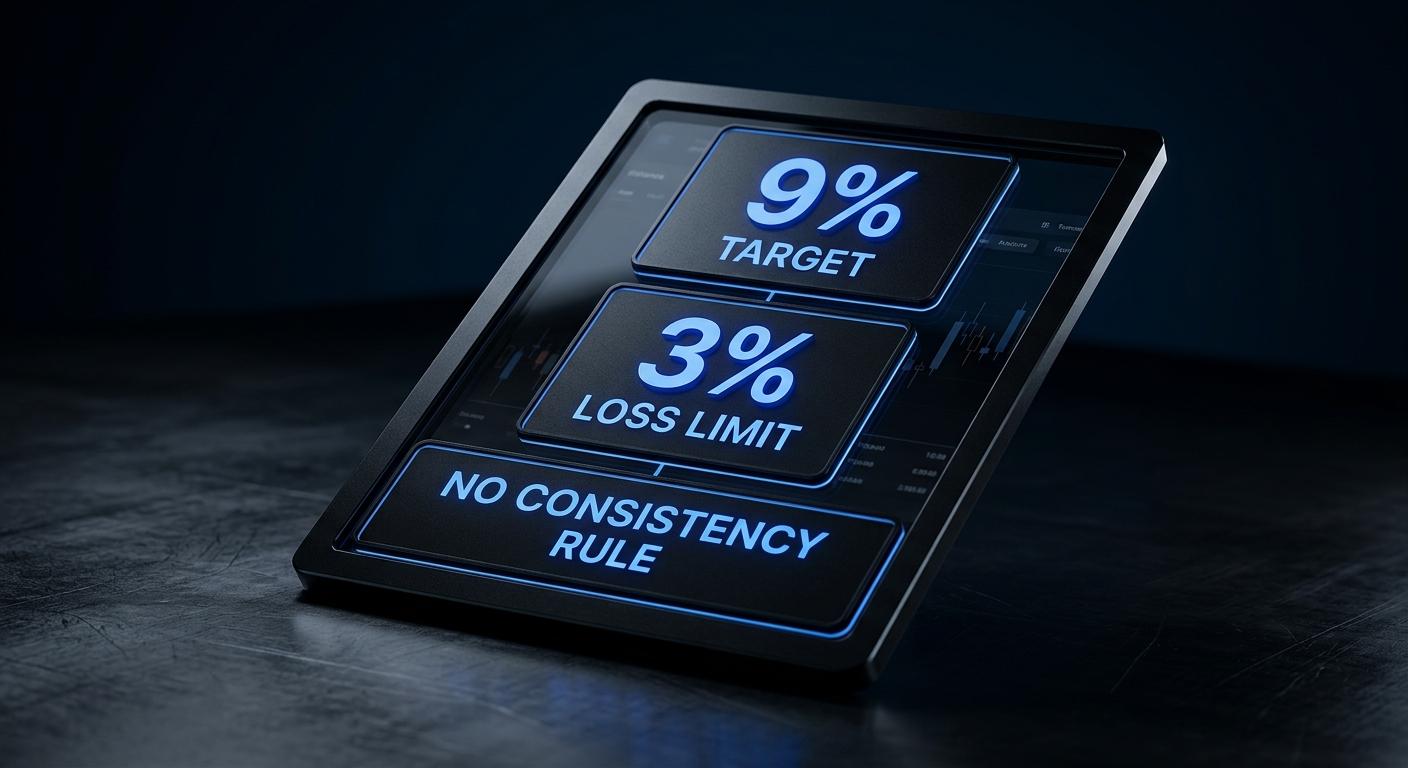
You hit the profit target, you didn’t touch your loss limit, and the dashboard still says you haven’t passed. More often than not, the consistency rule is the reason.
A consistency rule caps how much of your total profit can come from a single trade or a single day. It’s one of the most common rules in a prop firm evaluation, and one of the least understood. This guide explains what the rule is, how to calculate it, and how it works on each Vanquish plan.
For the rest of the rules on every plan, our Vanquish Trader rules overview has the full picture.
What is a consistency rule in trading?
A consistency rule measures how evenly your profit is spread. You compare your best result with your total profit, and that percentage has to stay below a set limit.
Consistency = Best trade or best day ÷ Total profit
If your best day made $400 and your total profit is $1,000, your consistency is 40%. On a plan with a 30% limit, that’s too concentrated. On a plan with a 50% limit, you’re fine.
Total profit is your net profit, so losing trades and losing days count against it. A bad day doesn’t just cost you money; it also pushes your consistency up.
Why prop firms use it
An evaluation is meant to show that you can trade a repeatable strategy. A single oversized trade that happens to work proves very little. Without a consistency rule, a trader could put the whole account on one high-risk bet, pass if it lands, and reset if it doesn’t.
The rule rewards traders who size steadily and build results over several trades or days. That’s the same behavior that tends to hold up once an account is funded.
Per-trade vs daily consistency
Firms measure consistency in one of two ways, and the difference changes how you trade.
Per-trade consistency compares your single best trade with your total profit. It doesn’t matter how many trades you take in a day; what counts is that no one trade carries the account. Adding contracts to an open position usually counts as the same trade, so scaling into a winner keeps all of its profit in one result.
Daily consistency compares your best day with your total profit. A day’s result is the net of every trade you closed that session. You can take one big trade or ten small ones, and what counts is the day’s total.
In practice, per-trade rules push you to keep position sizes even. Daily rules push you to spread your profit across sessions, which is why a daily rule also creates a practical minimum number of trading days.
How the consistency rule works on each Vanquish plan
Three of the four Vanquish plans have a consistency rule. On each one, going over the limit never breaches your account. It only decides when you can pass and when you can request a payout.
Plan | Type | Limit | Applies to | Resets after a payout? |
|---|---|---|---|---|
Per trade | Below 30% | Passing and every payout | No, it uses your full trade history | |
Daily | Below 30% | Passing and every payout | Yes | |
Daily | Below 50% | Passing and every payout | Yes | |
None | None | Not applicable | Not applicable |
If you’d rather not deal with a consistency rule at all, Rapid Express is the plan built for that. You pass as soon as you hit the 9% target on closed trades, even if a single trade gets you there.
How to calculate the consistency rule
The calculation takes two numbers: your best result (trade or day, depending on the plan) and your total net profit.
- Find your single best trade or best day.
- Add up your total profit, with losses subtracted.
- Divide the first number by the second.
There’s also a faster way to plan ahead. Divide your best result by the limit, and the answer is the total profit you need to beat. With a 30% limit, a $600 best day means you need more than $2,000 in total profit ($600 ÷ 0.30).
Example: per-trade consistency at 30%
You’re on a $50,000 Basic Options Evaluation with a $5,000 target. Over 14 trades you’ve made $5,200, and your best trade was a $1,800 run on GOOGL calls.
$1,800 ÷ $5,200 = 34.6%. You’re past the target, but not under 30% yet. Your total needs to beat $6,000 ($1,800 ÷ 0.30), so you need roughly another $800 from trades that are each smaller than that GOOGL winner.
Example: daily consistency at 50%
You’re on a $10,000 Rapid Elite Evaluation with a $900 target. Your trading so far:
Day | Profit or loss |
|---|---|
1 | +$600 |
2 | −$150 |
3 | +$300 |
4 | +$250 |
Total | $1,000 |
$600 ÷ $1,000 = 60%. The day 2 loss is doing real damage here: without it, you’d be at 52%. You need a total above $1,200 ($600 ÷ 0.50), so one more $200-plus day on something like AMD calls gets you through.
Quick reference: how much total profit you need
Use this as a simple consistency rule calculator. Find your best trade or best day on the left, and your total profit needs to be more than the figure for your plan’s limit.
Best trade or best day | Total needed at 30% (Basic, Advanced) | Total needed at 50% (Rapid Elite) |
|---|---|---|
$250 | More than $833.33 | More than $500 |
$500 | More than $1,666.67 | More than $1,000 |
$1,000 | More than $3,333.33 | More than $2,000 |
$2,500 | More than $8,333.33 | More than $5,000 |
$5,000 | More than $16,666.67 | More than $10,000 |
The figures have to be beaten, not matched. A $500 best day against exactly $1,000 of total profit is 50%, which isn’t below the limit.
What happens if your consistency is too high
Nothing breaks. On every Vanquish plan with a consistency rule, a high percentage doesn’t breach your account or count as a failed Evaluation. You simply can’t pass, or request a payout, until it comes down.
The only way to bring it down is more profit from results smaller than your best one. That’s worth knowing before you go hunting for it. Trying to fix consistency with one aggressive day often creates a new best day, and then you’re chasing an even bigger total.
Does consistency reset after a payout?
It depends on how the plan measures it.
- Daily plans reset. On Advanced Options and Rapid Elite, consistency starts fresh after each payout, so every payout cycle needs its own spread of days.
- Per-trade plans carry forward. On Basic Options, consistency is calculated across your full trade history. A long record of evenly sized trades keeps you eligible from one payout to the next.
That difference matters most when you plan withdrawals. On a daily plan, you can only get paid as often as you can rebuild a spread of days, which is a big part of why the payout rules vary so much from plan to plan.
What is a perpetual consistency rule?
Some firms only apply a consistency rule during the evaluation. Others keep it running once you’re funded, so it applies to every payout for the life of the account. That second version is often called a perpetual consistency rule.
On Vanquish, every plan that has a consistency rule applies it at both stages: once to pass the Evaluation, and again each time you request a payout from your Performance Account. If the jump between the two stages is new to you, here’s how the Evaluation and Performance Account differ.
Why a daily rule sets a minimum number of days
A daily consistency rule quietly decides the fewest days you can pass in.
With a 50% limit, two days can never work. Your better day is always at least half your total, so you need at least three. With a 30% limit, three days fall short too, because your best day is always at least a third of the total. You need at least four. That lines up with the four-trading-day minimum on Advanced Options.
How to stay within the consistency rule
- Keep your size steady. If your normal trade risks $200, a $1,000 position is where consistency problems start.
- Don’t stop the day you hit the target. If your best day is large, you may need a few more modest days before you pass.
- Watch your losing days. They lower your total and raise your percentage, often more than traders expect.
- Run the numbers before the session. Divide your best result by the limit, and you know exactly what total you’re working toward.
- Plan payouts around the reset. On daily plans, think of each payout cycle as a fresh run of several steady days.
Consistency rule FAQ
Does a consistency rule fail my account?
Not on Vanquish. Being over the limit doesn’t breach your account or fail your Evaluation. You keep trading until your percentage drops below the limit.
Do losing trades affect my consistency?
Yes. Losses reduce your total profit, and a smaller total makes your best result a bigger share of it.
Is consistency measured against my profit target or my total profit?
Your total profit. On Vanquish, consistency is always your best trade or best day divided by your total net profit, not by the profit target.
Which Vanquish plan has no consistency rule?
Rapid Express. It has no consistency rule in the Evaluation or on the Performance Account, so you can pass with a single trade.
How many days do I need to pass with a daily consistency rule?
At least three with a 50% limit and at least four with a 30% limit. Fewer days than that can’t get your best day under the limit.
Does adding contracts to a position count as a new trade?
No. On Basic Options, adding to or trimming the same position counts as one trade, so all of its profit goes toward that single result.
Ready to put it into practice? Compare the plans and choose an account size on the plans page.